

Safe Airport Transportation: Pickup Locations, Wait Time and Flight Tracking
A reliable airport ride is planned before you land. Safe airport transportation starts with arranging a ride from the airport to your destination in advance; transfers may be private or shared. Knowing where your driver will meet you and how pickup works can make the next step of your journey more manageable.
It’s reasonable to want clear arrangements after a flight, especially when you’re carrying luggage or travelling on a tight schedule. This guide explains what airport transfer services include and what to expect from terminal pickups and drop-offs, provider features, complimentary wait time and flight tracking.
You’ll also learn which details make a transfer more predictable, from understanding the meeting point to knowing how arrival delays may affect pickup. With those basics in hand, you can plan your airport journey with greater confidence and less guesswork.
Key Takeaways
- Understand how pre-arranged airport transfers work and how private and shared rides differ.
- Plan your terminal arrival by identifying the correct pickup or drop-off area before you travel.
- Learn which service features, including flight tracking and complimentary wait time, can make an airport pickup easier to manage.
- Use practical signs of licensing and legitimacy to assess an airport taxi or rideshare in Canada.
- See how a local airport transfer can help with a pre-arranged ride to or from the airport.
What is an airport transfer service?
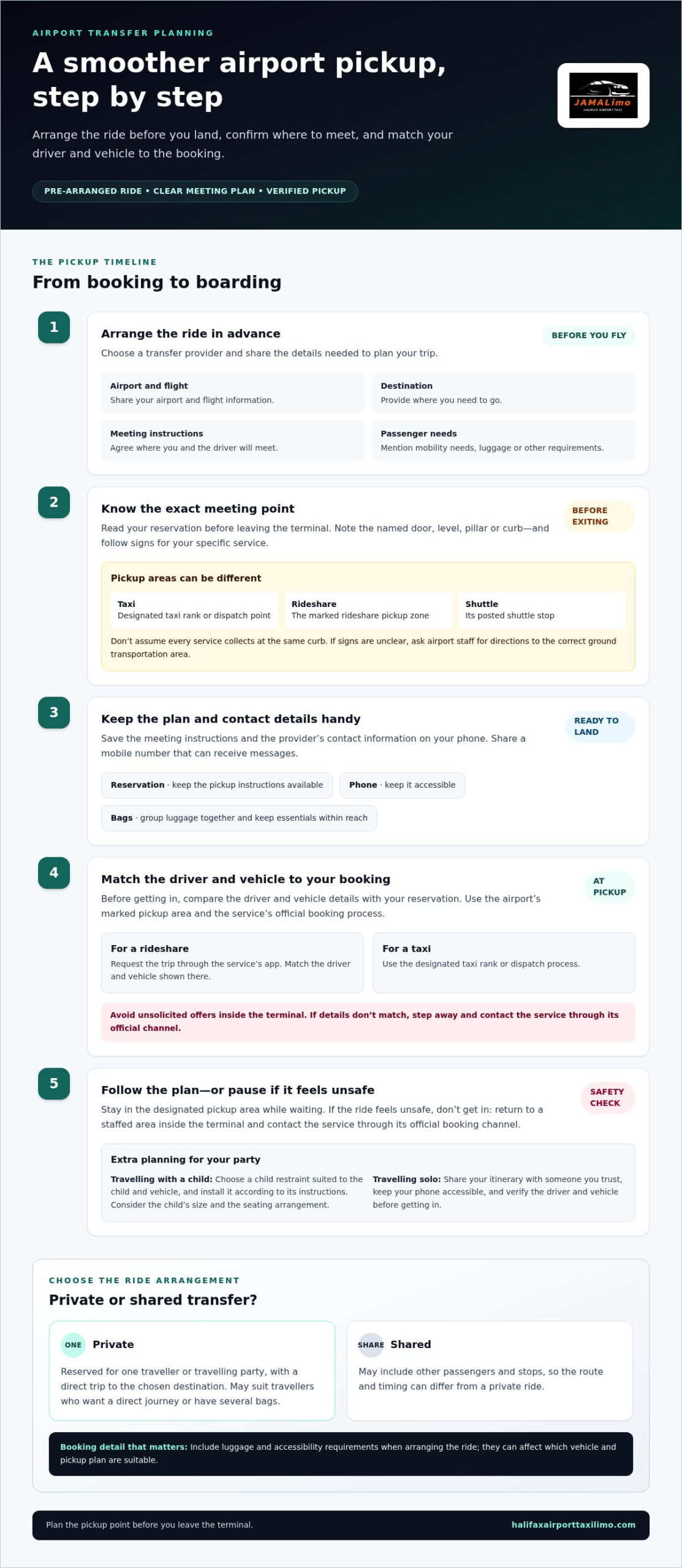
An airport transfer is transportation arranged in advance from an airport to a traveller’s destination. It may be private or shared, and the booking sets out the trip details. For a smooth pickup, provide the airport, flight information, destination and passenger needs when arranging the ride. These details make safe airport transportation easier to plan.
Pre-arranged transfer process
A pre-arranged transfer is an airport ride booked before the traveller arrives. The passenger shares trip details, including the flight, destination and preferred meeting instructions, then follows the agreed plan after landing. Knowing whether to meet inside Arrivals or at a designated curb can prevent confusion around parking areas and public pickup zones.
Before leaving the terminal, compare the vehicle description and driver details with your booking. Save the meeting instructions and provider’s contact information on your phone. If signs don’t make the pickup point clear, ask airport staff for directions to the correct ground transportation area.
Private transportation
Private transportation is a pre-arranged ride reserved for one traveller or travelling party, rather than shared with unrelated passengers. It takes the group directly to its chosen destination, such as a home, hotel or appointment.
This option can suit travellers who want a direct journey or have several bags. Shared transfers may include other passengers and stops, so the route and timing can differ. Include any mobility needs when arranging a ride, as accessibility requirements and luggage can affect which vehicle and pickup plan are suitable.
Driver and vehicle legitimacy
A legitimate airport ride has an identifiable driver and vehicle that match the passenger’s booking. Before getting in, compare the vehicle and driver information with your reservation. Use the airport’s marked pickup area and the taxi or rideshare service’s official booking process.
For a rideshare, request the trip through the service’s app and match the vehicle and driver shown there. For a taxi, use the designated rank or dispatch process. Avoid unsolicited offers inside the terminal. If the details don’t match, step away and contact the service through its official channel.
Child car seats: Choose a child restraint suited to the child and vehicle, and install it according to its instructions. Before travelling, account for the child’s size and the seating arrangement so the restraint is ready when the ride arrives.
Solo travellers: Share your itinerary with someone you trust, keep your phone accessible and compare the driver and vehicle with your booking before getting in. Stay in the designated pickup area while waiting.
If the ride feels unsafe: Don’t get in. Return to a staffed area inside the terminal and contact the taxi or rideshare service through its official booking channel.
Terminal pickup and drop-off locations
A terminal pickup is where a driver collects arriving passengers; a drop-off is where passengers leave for departures. The correct curb, door or level depends on the airport and service type. Compare your booking instructions with terminal signs before heading outside, as taxis, rideshares, buses and shuttles may use different areas.
Find the correct pickup point
Airport pickup zones are designated areas where passengers meet taxis, rideshares or other arranged transportation. Follow signs for your specific service instead of assuming every vehicle collects passengers at the same curb. A taxi rank, rideshare pillar and hotel shuttle stop may be separate locations, even when they all serve Arrivals.
Read your reservation before leaving the terminal and note the named door, level, pillar or curb. For example, if the instructions identify a rideshare pickup zone, don’t wait at the taxi rank. At a busy international airport, matching your service type to the posted sign can help prevent a missed connection.
Use the correct drop-off area
A terminal drop-off is the airport-designated place where a driver leaves departing passengers. Follow the signs for Departures and your airline’s terminal, then use the curb assigned to your ride type. Some areas allow passengers to exit vehicles but don’t permit waiting or loading, so keep the drop-off brief.
Bus riders, taxis, hotel shuttles and rideshares may each have separate loading zones. Check your service instructions before setting off, then follow airport signs as you approach the terminal. The terminal name alone may not identify the correct curb, particularly when an airport has multiple buildings or levels.
Prepare for luggage and assistance
Luggage assistance means help moving bags between the vehicle and the terminal entrance. Before your ride, group your bags together and keep essentials, such as identification and medication, within reach. If you need help with mobility equipment or oversized luggage, include that in your arrangements so the pickup plan accounts for it.
At a crowded curb, keep bags close while confirming the vehicle and driver. Avoid blocking a loading area as you organize suitcases. If you need directions, ask airport staff or customer service to help locate the correct transportation point.
Make the booking details useful
A useful booking includes the airport, terminal, arrival details, destination and a clear meeting point. Share a mobile number that can receive messages, and save the provider’s instructions before travelling. If the pickup point changes, use the reservation’s contact method and follow posted airport directions.
For an airport journey in Nova Scotia, a pre-arranged airport transfer can help you plan the pickup details before you travel.
Airport transfer providers and service features
An airport transfer provider arranges a ride between an airport and a passenger’s destination. Service features describe how pickup, the journey and arrival are managed. Comparing these details helps travellers choose an arrangement that suits their flight, luggage and schedule.
Airport taxis, rideshares, pre-booked private cars and shared transfers suit different needs. A taxi may be taken from a designated rank, while a pre-booked driver follows an agreed pickup plan. At Ottawa airport, a pre-booked transfer driver waits in the arrivals hall with a sign bearing the passenger’s name, making the meeting point easier to recognize after landing.
Airport authorization is a practical safety signal. Ottawa International Airport recommends airport-authorized transportation services for safety. At Edmonton International Airport, rideshare drivers must carry appropriate commercial insurance and Class 4 driver’s licences under Alberta legislation. Passengers can compare the vehicle and driver with their booking before getting in.
Pickup coordination connects flight arrival details with the meeting plan. For example, a traveller arriving at Ottawa can look for the name sign in the arrivals hall, then confirm the driver and destination. A station pickup may need different instructions from a terminal curb pickup, so clear location details matter.
Complimentary wait time is a stated period during which a passenger can wait without an added waiting charge. Its length and conditions depend on the provider’s policy, such as the booked pickup type and the time the driver arrives. Read the booking terms before travelling to understand how delays, baggage collection and meeting the driver fit the arrangement.
Flight tracking uses flight information to coordinate pickup with an arriving plane. It can help align the driver’s timing with a changed arrival, while traffic and airport pickup rules still affect the journey. Keep your flight number and booking details available, and follow the agreed instructions after landing.
To avoid airport transportation scams, book through an official company channel or use the airport’s authorized taxi or rideshare process. Don’t follow unsolicited offers inside the terminal, and get into a vehicle only if it matches your booking details.
Before confirming a ride, compare its features with your needs: arrival coordination, meeting instructions, wait-time terms, luggage requirements and destination. For example, a family with several bags may prioritize a direct pickup plan, while a solo passenger may value a clearly identified driver and vehicle.
Travellers with accessibility needs may wish to confirm vehicle access before booking. Accessible taxi vehicles at Edmonton International Airport can be reserved by contacting the taxi company or the Ground Transportation Office in advance. Travellers using Abbotsford-area taxi providers should give the company advance notice to help ensure availability.
Group size and timing can also shape the choice. A group shuttle vehicle has 12 seats, and a group shuttle scenario has passengers waiting in the parking lot for 40 minutes. That arrangement may suit passengers travelling together, but the wait and pickup setting should be weighed against individual schedules and comfort. Confirming availability and meeting instructions ahead of departure can help set expectations.
Complimentary wait time and flight tracking
Complimentary wait time is an included period for meeting a booked driver after a flight arrives. Its length and start point depend on the reservation terms. For example, the clock might start at the scheduled arrival, landing or another pickup milestone. Know which event applies before travelling, so baggage collection and reaching the meeting point fit the plan.
Flight tracking uses flight status information to coordinate a scheduled airport pickup. A flight can arrive earlier or later than its ticket schedule, while passengers still need time to leave the aircraft and collect bags. Tracking can help a driver adjust timing when arrival details change, but it doesn’t replace clear pickup instructions or account for every delay inside the terminal.
Before departure, save your reservation, flight number and driver’s meeting instructions together. After landing, check the latest flight status and follow the booked plan. If the instructions say to meet inside Arrivals, don’t go outside to the curb first. If they name a curb or pickup zone, follow the airport signs and go there after collecting your luggage.
Wait-time terms matter most when a flight is delayed, baggage takes longer or a passenger needs extra time to reach the pickup point. Read how the included period is counted and what happens when it ends. If you have checked luggage, allow time to reach baggage claim before contacting the driver or leaving the terminal.
Flight tracking and complimentary waiting address different parts of pickup. Tracking concerns the aircraft’s arrival information; waiting concerns the time allowed for the passenger and driver to meet. Neither guarantees a quick exit from a busy airport. Keep your phone charged, save the driver’s contact details and send a concise update if the agreed meeting time or location changes.
For a family arriving at Toronto Pearson, the practical sequence is simple: check the flight status, collect bags, then follow the reservation’s meeting instructions. A passenger travelling with only a carry-on may reach pickup sooner but should still use the agreed meeting point. This keeps the driver and traveller aligned without assuming how quickly arrivals will move.
At the airport, stay in the designated pickup area instead of accepting an unsolicited ride outside. If you can’t find the driver, compare the vehicle details with the reservation and use its contact method. Clear timing terms, current flight details and one agreed meeting point make pickup easier to manage.
How can I verify that an airport taxi or rideshare is licensed and legitimate in Canada?
A licensed airport ride is a taxi or rideshare operating under the rules that apply to its location. Requirements vary across Canada, so use the airport’s official transportation instructions and the booking service’s identification details. At Edmonton International Airport, rideshare drivers must carry appropriate commercial insurance and Class 4 driver’s licences under Alberta legislation.
A legitimate ride matches the passenger’s booking and uses the airport’s designated pickup process. Before getting in, compare the vehicle and driver with your reservation. A different vehicle, an unexpected driver or an unsolicited offer inside the terminal is a reason to pause and use the official booking channel.
Use these practical checks at the airport:
- Follow airport signs. Go to the marked taxi rank or rideshare pickup area, rather than accepting a ride elsewhere at the curb.
- Match the booking. Compare the vehicle description, licence plate and driver details shown in the app or reservation.
- Confirm the ride. Ask the driver to identify the passenger or destination without sharing unnecessary personal information.
- Use the official process. Book through the company’s stated channel or an airport-authorized service, and keep the confirmation available.
At Edmonton International Airport, the Class 4 licence and commercial insurance requirements apply to rideshare drivers under Alberta legislation. That example shows why location matters: an airport in another province may have different requirements or verification steps. Don’t assume one province’s rules automatically apply across Canada. Start with the specific airport’s ground transportation information, then compare it with the driver and vehicle details provided for your trip.
For a taxi, use the airport’s marked taxi stand or dispatch process instead of responding to someone offering an informal ride. For a rideshare, request the trip through the app and wait at the pickup point it identifies. If a driver asks you to change locations, check your reservation instructions before moving to another area.
If the driver or vehicle doesn’t match, don’t get in. Step back into the terminal, find an airport information desk or official transportation counter, and report the mismatch through the booking channel. Keep your phone and confirmation accessible, especially when travelling alone or arriving late.
For a planned trip to or from Halifax Stanfield International Airport, arrange Local Halifax Airport Transfers with your pickup details ready.
Toronto Pearson International Airport welcomes millions of visitors to Canada every year, while Ottawa Macdonald-Cartier International Airport is described as the second busiest airport in Canada. At Edmonton International Airport, rideshare vehicles cannot be hailed in person or use the taxi stands; taxi drivers must complete the Blue Tag Taxi Ambassador Course, a training program in partnership with NorQuest College. Taxi service is also available between the Abbotsford International Airport terminal and the nearest Central Fraser Valley Transit bus stop. Check the airport’s own instructions to find which service and pickup method applies to your trip.
JAMALimo: Local Halifax Airport Transfers
JAMALimo provides safe airport transportation for travellers going to or from major Canadian airports. Its licensed and insured drivers travel in sedans, SUVs and minivans, giving passengers vehicle options for their journey. If your plans extend beyond your initial arrival point, regional airport transfers and interprovincial car service can support travel between destinations. Custom tours are another option for visitors planning time to sightsee. These services suit travellers who want a pre-arranged ride rather than public transit, with the trip focused on their destination. Share your airport and destination details when arranging transportation so the journey matches your plans. Contact JAMALimo to discuss an airport transfer or another suitable service for safe airport transportation.
Plan your next airport journey with confidence
Your next airport journey is easier to organize when the ride is part of your travel plan, not a last-minute decision. Before departure, consider where you’re going after landing and what kind of trip suits your plans. That simple step can make safe airport transportation more straightforward from the start.
For travel connected to Halifax Stanfield International Airport, JAMALimo offers Local Halifax Airport Transfers and Nova Scotia Airport Transfers. Inter Provincial Car Service is another option for journeys that continue beyond Nova Scotia. Choose the service that aligns with your destination, then prepare the trip details you’ll need to arrange your ride.
Contact JAMALimo about airport transportation to discuss your travel plans. A little preparation now can help you set off with greater ease and look forward to the journey ahead.
Frequently Asked Questions
What are the safest ways to get to and from Canadian airports?
Choose a transport option with a clear booking process, identifiable vehicle and suitable pickup plan. For example, a pre-arranged ride can suit travellers with late arrivals or several bags, while public transit may work well for someone travelling light along a direct route. Before leaving, save your destination and travel details, keep your phone accessible, and tell someone you trust how you’re travelling.
How do airport taxis, rideshares, public transit, and shuttles compare for safety in Canada?
No transport type is automatically safest for every airport trip; the route, time and passenger’s needs matter. Taxis and rideshares offer direct travel, while public transit and shuttles use set routes or stops and may involve walking or waiting with luggage. For a solo passenger arriving late, a direct ride may reduce transfers; for a daylight trip with a convenient route, transit may be practical. Use designated pickup areas and follow the service’s booking instructions.