

Business Executive Car Travel for Corporate Trips
The right vehicle can make business travel simpler from pickup to arrival. Business executive car travel can be arranged in a sedan for an individual trip, an SUV for extra passenger or luggage space, or a minivan for a group travelling together. For business trips in Canada, executive car services can also cover airport transfers and longer journeys between provinces.
For a scheduled meeting or flight, punctual service, a professional driver, and a comfortable ride matter. Choose a vehicle based on your group size, luggage, route, and the type of trip.
This guide explains how executive car services fit into business travel, compares sedan, SUV, and minivan options, and outlines practical booking considerations. It also covers when an airport transfer or interprovincial car service can help keep a corporate itinerary straightforward.
Key Takeaways
- Recurring corporate trips may be easier to manage with standing billing terms and consolidated monthly invoicing.
- For a same-day business trip, arranging transportation as early as possible can help with availability.
- Choose a sedan, SUV, or van based on your group, luggage, and itinerary to keep the ride practical and comfortable.
- For Halifax airport pickups or travel between provinces, JAMALimo’s transfer services can support a smoother corporate itinerary.
Why Choose Executive Car Services Over Standard Transportation?
For a client visit, board meeting, or airport transfer, executive transportation brings the vehicle, pickup plan, and schedule together. It can also suit recurring trips, roadshows, and intercity journeys where several stops need coordinating.
In Canada, safety, insurance, and licensing requirements depend on the province or territory and the type of commercial car service. Requirements can therefore differ by jurisdiction and service. JAMALimo’s drivers are licensed, insured, and nationally certified.
Canadian businesses may deduct the portion of motor vehicle expenses related to earning business income. The Canada Revenue Agency sets the applicable limits, so keep records that distinguish work-related travel from personal use.
For recurring transportation, a corporate account can bring regular bookings together under standing billing terms and consolidated monthly invoicing. This lets finance teams review charges collectively instead of processing each airport transfer separately. For example, a company arranging regular airport pickups for visiting staff can use one account structure for those trips. A consistent booking process also helps coordinators share pickup details and itinerary changes clearly.
Roadshows need more than a ride between two addresses. A schedule might include an airport pickup, a morning client meeting, a second office visit, and an evening hotel drop-off. Sharing the full itinerary lets dispatch coordinate each stop and account for luggage between appointments. Flight tracking can help adjust an airport pickup when a flight is delayed, while discreet service supports business conversations during the ride.
Centralized booking arrangements can make recurring transportation easier to administer across employees or departments. A designated travel coordinator can arrange trips, provide passenger names and pickup details, and direct invoices to the appropriate billing contact. For a delegation visiting several sites, keeping bookings together can make trip records easier to review. Clear trip details also help match the vehicle to the passenger count and luggage.
Fleet choice matters. A sedan can suit an individual travelling light, while an SUV or minivan may better accommodate a group or extra luggage. For a multi-stop itinerary, matching vehicle capacity to the group can avoid coordinating separate vehicles and schedules.
Advance booking and same-day availability
Book once the itinerary is clear so the pickup details, flight schedule, meetings, and route can be planned together. For same-day travel, arrange the car as early as possible.
Advance booking and dispatch
When booking, share the pickup address, destination, passenger count, luggage needs, and requested arrival time. For an airport pickup, provide flight details so the journey can be coordinated with your arrival. List every stop in order for a road itinerary, along with any planned waiting time. Clear details help the driver follow the schedule and keep the booking aligned with the journey requested.
Same-day availability
For a same-day client visit, arrange transportation as early as possible. Include the meeting start time, pickup point, and latest acceptable arrival time. These details help plan the trip around the route and schedule. If a flight delay affects an airport pickup, JAMALimo’s real-time flight tracking helps coordinate pickup timing.
Keep booking information focused on transportation needs. A travel coordinator can provide the passenger’s name, pickup location, flight information, and relevant contact details to the people arranging the ride. Avoid putting sensitive meeting notes in the booking. Dispatch needs the destination and timing, for example, not the purpose of a confidential meeting.
To manage business trips, send the full itinerary, identify the booking contact, and specify where billing information should go. For recurring journeys, use a consistent booking process so staff can submit trip details clearly. Update dispatch if a meeting moves or a flight changes, since those details affect pickup timing and routing.
For intercity itineraries, interprovincial business travel can be arranged around the route and planned stops.
Luxury vehicle fleet and passenger capacity
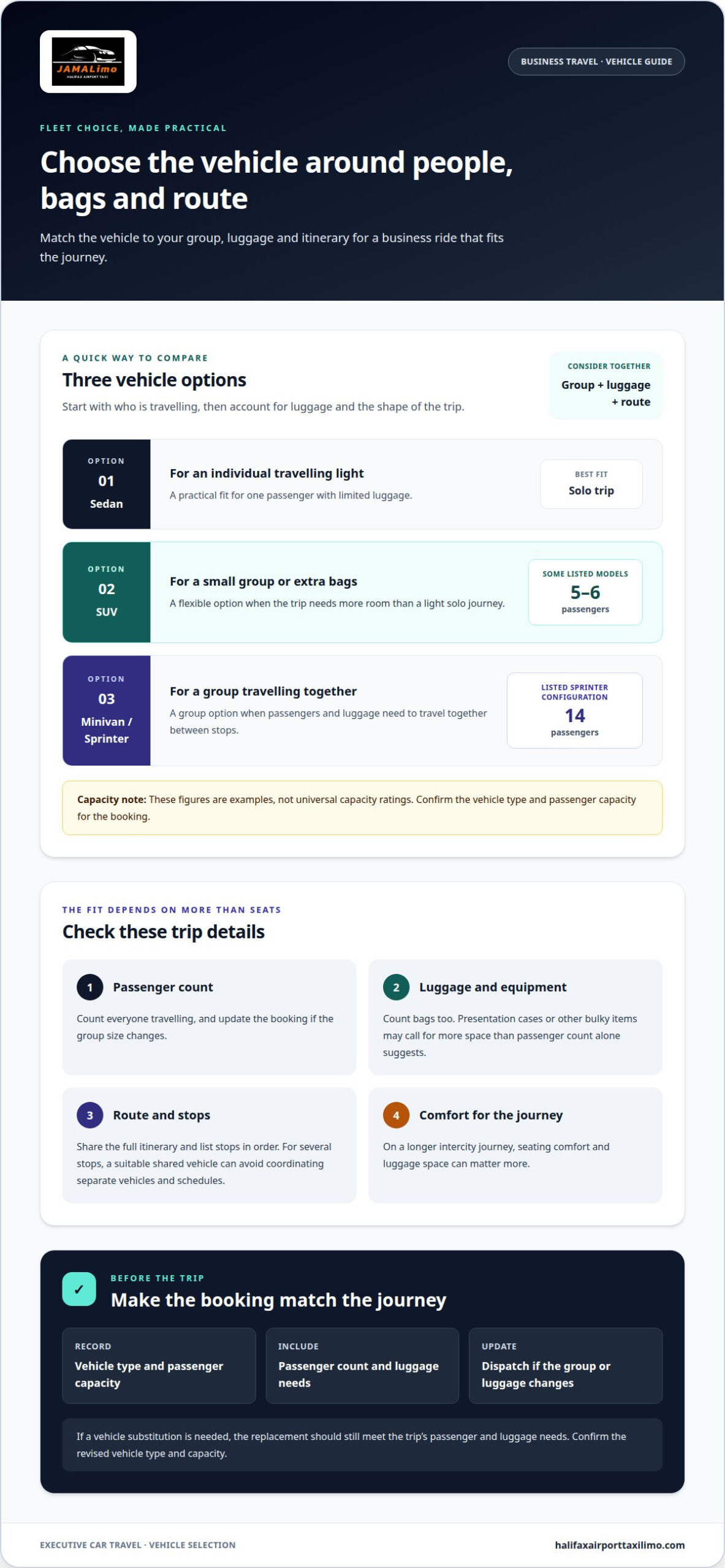
Match the vehicle to the passenger count, luggage, route, and comfort needs. A sedan can suit an individual executive, while an SUV or minivan can accommodate a group. In Canadian executive fleets, listed SUVs may seat 5-6 passengers, and a Sprinter configuration may seat 14. Treat those figures as examples, not universal capacity ratings.
Passenger capacity is only one part of the choice. Count passengers and bags, then consider whether everyone needs to travel together between stops. A small team travelling with presentation cases, for example, may need more space than the passenger count alone suggests. On a longer intercity journey, seating comfort and luggage space can also matter more.
- Sedan: A practical fit for an individual passenger with limited luggage.
- SUV: A flexible option for a small group or extra bags; some listed models seat 5-6 passengers.
- Minivan or Sprinter: A group option; a listed Sprinter configuration accommodates 14 passengers.
Ask for the vehicle type and passenger capacity to be recorded in the booking. If the group size or luggage changes, update those details before travel. This gives dispatch a clear basis for assigning a suitable vehicle, rather than relying on an earlier passenger estimate.
Vehicle substitutions can happen if the originally planned vehicle becomes unavailable. A suitable replacement should still meet the trip’s passenger and luggage needs. A sedan, for instance, is not a like-for-like replacement for a group booked into a minivan. Confirm the revised vehicle type and capacity, especially when several passengers or bulky equipment are involved.
Before finalizing a trip, review the booking terms for cancellation, waiting time, payment, and invoicing. Check any cancellation notice conditions, included waiting period, how additional waiting is billed, and accepted payment or invoicing arrangements alongside the vehicle details.
A clean, well-maintained vehicle and a suitable passenger layout support comfort on the road. For intercity travel, matching the vehicle to the group and luggage helps keep the journey practical from pickup to arrival.
Executive sedan, SUV and van fleet options
In Canada, executive car travel can include airport pickups, intercity journeys, and multi-stop corporate itineraries. A chauffeur service pairs a professional driver with a vehicle suited to the route, passenger count, and luggage. For a seamless pickup, provide the location, schedule, and passenger details when arranging transportation.
Choose a vehicle based on the trip, not appearance alone. Sedans suit individual travel or a small number of passengers with limited luggage. An SUV can provide more room for a team, while a minivan can keep a larger group together and avoid coordinating separate pickups and arrival times.
- Sedan: Consider it for one executive travelling between an airport and a meeting.
- SUV: Choose it for a small team, extra luggage, or a longer intercity route.
- Van: Use it when a delegation needs to travel together between several stops.
Capacity details help make the choice concrete. Listed executive SUVs can seat 5-6 passengers, while a VIP Executive Sprinter configuration accommodates 14 passengers. These examples show why passenger count and luggage should be considered together. A group with presentation cases may need more room than the number of travellers suggests.
For corporate travel, share the itinerary and passenger count before dispatch assigns a vehicle. If plans change, update the pickup time, stop sequence, or luggage needs. Those details help the driver prepare for the revised journey and support punctuality at each stop. A clean, maintained vehicle and a suitable layout also make longer drives more comfortable.
For a roadshow, match the vehicle to the group and planned stops, then keep pickup details consistent across the itinerary. Plan your next intercity trip with the route and passenger needs in mind.
JAMALimo
JAMALimo provides Inter Provincial Car Service for business travellers planning longer journeys between provinces. Share the pickup and destination when arranging a scheduled trip to keep the ground transportation plan straightforward.
When arranging the trip, share your route, pickup point, passenger count, and schedule. These details help align the booking with your business itinerary, whether you’re travelling between meetings or heading to a destination in another province.
Contact JAMALimo to discuss your business travel plans.
Plan Your Next Corporate Journey with Confidence
A smooth business trip starts by including transportation in the itinerary, rather than leaving it until the last minute. For business executive car travel, decide who is travelling, where each journey begins, and how the ride fits around meetings. A clear plan gives your team a practical starting point for coordinating pickups and focusing on the work ahead.
JAMALimo offers Inter Provincial Car Service for business trips between provinces. Share your route and schedule when arranging the ride so the booking can fit your itinerary.
Contact JAMALimo about business travel to discuss your itinerary. With the transportation plan in place, you can turn your attention to the purpose of the trip and travel with greater peace of mind.
Frequently Asked Questions
Do you offer a corporate chauffeur service for business travel?
Yes, business executive car travel can be arranged through JAMALimo’s executive transportation services. Options include airport transfers and Inter Provincial Car Service for longer journeys. Licensed, insured, nationally certified professional drivers provide the ride. For example, a coordinator can arrange transportation for a visiting executive travelling from an airport to a scheduled appointment, or for colleagues travelling between provinces.
Can I book an executive car for a same-day client visit?
Yes, you can request a same-day booking. Arrange it as early as possible and provide the pickup point, destination, passenger count, and required arrival time. If a meeting moves to today, share the new schedule promptly so the trip can be planned around the revised route. For an airport pickup, provide flight details; JAMALimo uses real-time flight tracking to coordinate pickup timing.
How far in advance should I book?
Book as early as your itinerary allows, especially when flights, meetings, or several stops need coordinating. Share the date, route, pickup time, and vehicle needs when arranging the ride. Once a conference schedule is settled, arranging the airport pickup and onward journey together gives transportation a clear place in the trip plan.
What makes a car service suitable for a client visit or board meeting?
A suitable service supports punctuality, discretion, and a professional arrival. Provide a clear pickup location, destination, and meeting start time. For a board meeting at a large office or hotel, specifying the correct entrance can reduce confusion at pickup. JAMALimo’s clean, sanitized vehicles and professional drivers help the ride fit smoothly into a business schedule.
Which vehicle is right for my group?
Choose according to passenger count, luggage, and whether everyone should travel together. A sedan can suit an individual executive, while an SUV or minivan can accommodate a group. Market examples list executive SUVs for 5-6 passengers and VIP Executive Sprinter configurations for 14. JAMALimo’s fleet includes clean, sanitized luxury-style sedans, SUVs, mini-vans, black cars, and stretch limousines. Clean, Sanitized Cars – Your safety matters.
How does executive car service compare with taxis, rideshare, and rental cars?
An executive car service is arranged around a planned pickup and itinerary, making it useful for scheduled meetings or intercity travel. A taxi or rideshare can suit an individual point-to-point trip, while a rental car leaves driving and parking to the traveller. For a delegation travelling together, a pre-arranged vehicle can simplify coordination; independent travellers with flexible stops may prefer driving themselves.